
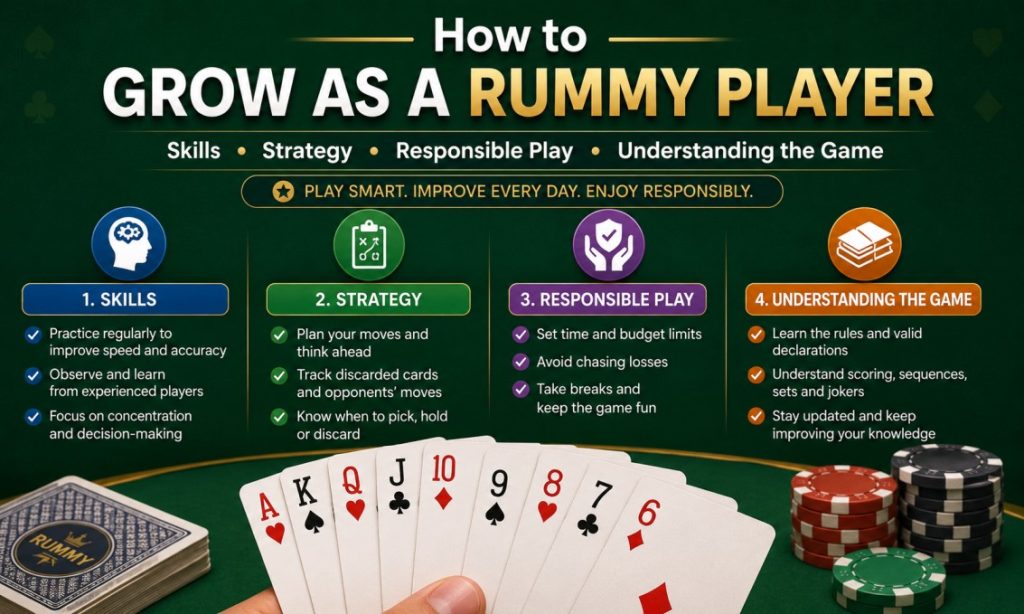
Introduction
Rummy is one of the most popular card games played around the world. It combines skill, observation, decision-making, and patience, making it an engaging experience for players of all levels. Whether played casually among friends or on online platforms, rummy has gained a reputation as a game that rewards strategic thinking and careful planning.
Many new players are attracted to rummy because of its competitive nature and the possibility of winning rewards in certain formats. However, becoming a successful rummy player is not just about luck. Long-term improvement comes from understanding the rules, practicing regularly, learning from mistakes, and maintaining discipline.
In this article, we will explore how players can grow in rummy, develop stronger skills, manage risks responsibly, and improve their overall gameplay experience.
Understanding the Basics of Rummy
Before trying to improve, every player should have a strong understanding of the game’s fundamentals.
The objective of rummy is generally to arrange cards into valid sequences and sets before opponents do. Success depends on making the right decisions based on the cards available and predicting what other players might be collecting.
Key concepts include:
- Pure sequences
- Impure sequences
- Sets
- Jokers and wild cards
- Card grouping
- Discard pile management
A solid foundation helps players make smarter decisions during gameplay and avoid common beginner mistakes.
The Importance of Consistent Practice
Like any skill-based activity, improvement in rummy comes through practice.
Experienced players often spend time:
- Learning different game variations
- Reviewing previous games
- Identifying recurring mistakes
- Testing new strategies
- Observing stronger opponents
Consistent practice helps players recognize card patterns more quickly and make better decisions under pressure.
A beginner may initially focus only on arranging cards. Over time, however, experienced players learn to think several moves ahead and anticipate possible outcomes.
Developing Strategic Thinking
One of the biggest factors that separates average players from strong players is strategic thinking.
Successful rummy players often:
1. Focus on Building a Pure Sequence First
A pure sequence is usually essential for a valid declaration. Building one early can provide flexibility for organizing the remaining cards.
2. Track Opponents’ Moves
Observing which cards opponents pick or discard can reveal valuable information about their strategy.
Questions skilled players ask include:
- Which suit is the opponent collecting?
- Are they building a sequence or a set?
- Which cards should I avoid discarding?
3. Minimize High-Value Cards
Holding high-value cards for too long can increase penalties if another player declares first.
Many experienced players discard unnecessary high-value cards when they no longer fit their strategy.
Learning from Every Game
Growth in rummy does not happen overnight.
One of the most effective habits is reviewing completed games.
Players can ask themselves:
- What mistakes did I make?
- Which decisions worked well?
- Did I discard an important card?
- Did I miss an opportunity to form a sequence?
Analyzing past performance helps players avoid repeating errors and continuously improve.
Even losses can become valuable learning experiences when approached with the right mindset.

Rummy Modern: The Ultimate Guide, Review, Strategies & Everything You Need to Know in 2026
Managing Emotions During Gameplay
Emotional control is often overlooked but plays a major role in performance.
Some players make poor decisions when they:
- Become frustrated after losses
- Feel overconfident after wins
- Rush their moves
- Chase outcomes emotionally
Strong players stay calm regardless of results.
They understand that every game is different and that good decision-making matters more than short-term outcomes.
Patience and discipline are essential qualities for long-term growth.
Building Observation Skills
Observation is one of the most powerful tools in rummy.
Every action at the table provides information.
Players who pay attention can learn:
- Which cards opponents need
- Which cards are safe to discard
- When an opponent is close to declaring
- How the game is progressing
Improving observation skills often leads to better strategic decisions and stronger overall performance.
Understanding Probability and Card Distribution
Advanced players often develop an understanding of probability.
While rummy is not entirely predictable, players can estimate:
- The likelihood of drawing needed cards
- The availability of certain cards
- The risk of holding incomplete combinations
Probability helps players make more informed choices and reduce unnecessary risks.
Over time, this understanding becomes a natural part of decision-making.
The Role of Patience
Many beginners try to complete combinations too quickly.
However, patience is often rewarded in rummy.
Strong players know when to:
- Wait for the right card
- Change strategies
- Hold useful cards
- Let go of difficult combinations
Patience helps players avoid impulsive decisions and improve consistency.
Improving Decision-Making Skills
Every turn in rummy requires a decision.
Players must choose whether to:
- Pick from the open pile
- Draw a fresh card
- Discard a specific card
- Keep or break a combination
The quality of these decisions often determines success.
Improved decision-making comes from:
- Experience
- Practice
- Observation
- Game analysis
As players gain experience, their choices become faster and more accurate.
Setting Realistic Expectations
One important lesson for every rummy player is understanding realistic expectations.
No strategy guarantees success in every game.
Results can vary because of:
- Card distribution
- Opponent decisions
- Game conditions
- Random factors
Successful players focus on improving their skills rather than expecting immediate results.
Long-term improvement is usually more valuable than short-term outcomes.
Responsible Participation and Risk Awareness
Whenever rummy is played in formats involving money, responsible participation becomes extremely important.
Players should:
- Set clear limits
- Use only discretionary funds
- Never spend money they cannot afford to lose
- Take breaks regularly
- Avoid emotional decision-making
Responsible play helps maintain a healthy relationship with the game.
It is important to remember that financial outcomes are never guaranteed, and participation should always be viewed as entertainment rather than a reliable source of income.

Rummy Bonus: Complete Guide to Online Rummy Bonuses in 2026
Common Mistakes Beginners Make
Many new players make similar mistakes.
Holding High Cards Too Long
Keeping high-value cards without a clear plan can increase risk.
Ignoring Opponent Behavior
Focusing only on one’s own cards can lead to missed opportunities.
Declaring Too Quickly
Some players rush to declare and make validation errors.
Lack of Patience
Impulsive decisions often weaken overall strategy.
Playing Emotionally
Frustration and overconfidence can both lead to poor choices.
Recognizing these mistakes early can significantly improve performance.
Building a Growth Mindset
A growth mindset is one of the most valuable assets for any rummy player.
Instead of viewing losses as failures, successful players see them as opportunities to learn.
Characteristics of a growth mindset include:
- Continuous learning
- Openness to feedback
- Willingness to adapt
- Long-term thinking
- Positive attitude toward improvement
Players who adopt this mindset often progress more steadily over time.
Developing Consistency
Consistency is often more important than occasional success.
Strong players focus on:
- Making sound decisions
- Following proven strategies
- Avoiding unnecessary risks
- Maintaining discipline
Consistent habits tend to produce better long-term results than relying on luck or unpredictable outcomes.
The Importance of Focus
Distractions can negatively affect performance.
Players often benefit from:
- Playing in a quiet environment
- Avoiding multitasking
- Paying attention to every turn
- Tracking important cards
Better focus leads to better observation, faster thinking, and improved decision-making.

Aaj Kal Rummy Apps Kis Tarah Ke Bonus Dete Hain?
Adapting to Different Opponents
Every opponent has a unique playing style.
Some players are aggressive.
Others are cautious.
Some reveal patterns easily, while others are difficult to predict.
Successful players learn how to adapt.
Flexibility allows them to respond effectively to changing situations and different types of competition.
Continuous Learning
Even experienced players continue learning.
They may:
- Study advanced strategies
- Watch expert gameplay
- Participate in discussions
- Analyze trends
- Explore different variations of rummy
Continuous learning helps players remain competitive and refine their skills.
Conclusion
Rummy is a fascinating game that combines skill, observation, strategy, patience, and decision-making. Growth in rummy does not happen through shortcuts. Instead, it comes from understanding the game deeply, practicing consistently, learning from mistakes, and maintaining discipline.
Players who focus on improving their skills, observing opponents, managing risks responsibly, and developing a growth mindset often enjoy a more rewarding experience. While some formats may involve monetary rewards, it is important to approach them responsibly and understand that outcomes are never guaranteed.
Ultimately, the true value of rummy lies in the challenge of strategic thinking, the excitement of competition, and the satisfaction that comes from continuous improvement. By staying committed to learning and responsible play, players can enhance their understanding of the game and enjoy their rummy journey for years to come.
Rummy is a popular card game in which players arrange cards into valid sequences and sets to complete their hand before their opponents.
Rummy involves both skill and chance. While the cards dealt are random, strategic decision-making, observation, and experience play a major role in long-term success.
Beginners can improve by learning the rules thoroughly, practicing regularly, observing opponents, analyzing past games, and developing effective card management strategies.
A pure sequence is a group of consecutive cards of the same suit formed without using a joker. It is usually required for a valid declaration.
Observation helps players understand opponents’ strategies by tracking the cards they pick and discard, allowing for smarter gameplay decisions.
Common mistakes include holding high-value cards for too long, ignoring opponents’ moves, rushing declarations, and making emotional decisions during gameplay.
Strategy is one of the most important aspects of rummy. Players who plan ahead and adapt to changing situations often perform better than those who rely solely on luck.
Yes, many online platforms offer practice games, tutorials, and beginner-friendly formats that help players learn and improve their skills.


Leave a Reply