
Introduction
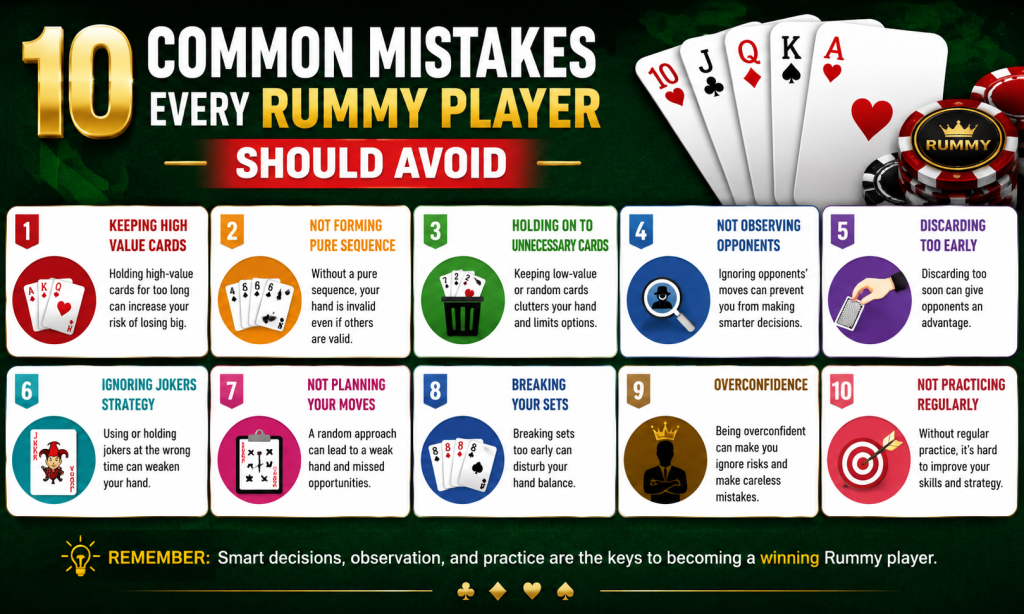
Rummy is one of the most popular card games enjoyed by millions of players worldwide. While the game may appear simple at first, becoming a successful rummy player requires a combination of skill, observation, patience, and strategic thinking. Many players focus solely on forming sequences and sets but often overlook common mistakes that can negatively impact their overall performance.
Whether you are a beginner learning the basics or an experienced player looking to improve your gameplay, understanding and avoiding common mistakes can make a significant difference. Small errors repeated consistently can lead to poor results, while smart decisions can help improve your performance over time.
In this guide, we will explore the 10 most common mistakes rummy players make and how you can avoid them to become a more confident and strategic player.
1. Ignoring the Importance of a Pure Sequence
One of the biggest mistakes beginners make is focusing on sets and other combinations before creating a pure sequence.
A pure sequence is generally a mandatory requirement for a valid declaration. Without it, even a well-arranged hand may not qualify.
Many players become distracted by attractive card combinations and spend too much time collecting sets while neglecting the most important objective.
How to Avoid This Mistake
- Prioritize forming a pure sequence early in the game.
- Evaluate your opening hand carefully.
- Build your strategy around completing the pure sequence first.
Creating a pure sequence early gives you more flexibility for organizing the remaining cards.
2. Holding High-Value Cards for Too Long
Many players become attached to face cards such as Kings, Queens, Jacks, and Aces.
While these cards can be useful, holding them unnecessarily increases risk if another player declares before you complete your hand.
High-value cards often contribute significantly to penalty points.
How to Avoid This Mistake
- Assess whether high cards fit your strategy.
- Discard unnecessary high-value cards early.
- Reduce potential penalties whenever possible.
Smart players know when to let go of cards that are no longer helping their game plan.
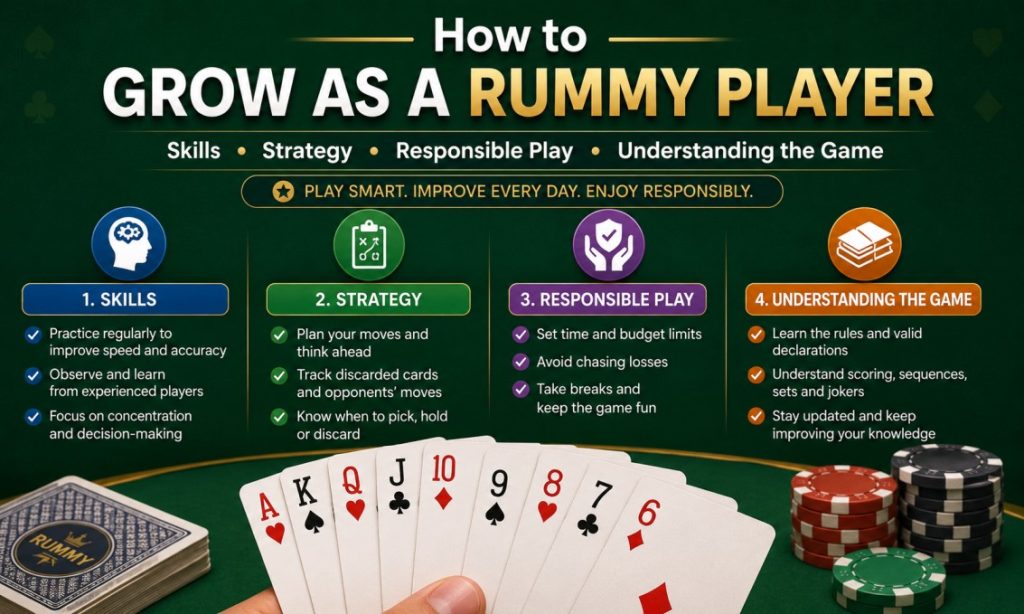
How to Grow as a Rummy Player: Skills, Strategy, Responsible Play, and Understanding the Game
3. Not Paying Attention to Opponents
Rummy is not only about your cards.
Many players focus entirely on arranging their hand and completely ignore what opponents are doing.
Every card picked and discarded provides useful information.
How to Avoid This Mistake
Observe:
- Which cards opponents pick from the open pile.
- Which cards they repeatedly ignore.
- What suits they appear to be collecting.
Tracking these patterns can help you avoid giving opponents useful cards while improving your own strategic decisions.
4. Making Emotional Decisions
Emotions often lead to poor gameplay.
Some players become frustrated after a bad draw or excited after receiving favorable cards.
Emotional reactions can cause rushed decisions and strategic mistakes.
Common Emotional Mistakes
- Panic discarding
- Chasing difficult combinations
- Overconfidence after previous wins
- Frustration after losses
How to Avoid This Mistake
- Stay calm during every game.
- Focus on the current hand.
- Make decisions based on logic rather than emotion.
Strong players remain disciplined regardless of temporary results.
5. Keeping Too Many Unconnected Cards
Another common mistake is holding multiple cards that do not contribute to any sequence or set.
Players often hope these cards will become useful later.
Unfortunately, keeping too many unrelated cards reduces flexibility and creates confusion.
How to Avoid This Mistake
Regularly evaluate your hand.
Ask yourself:
- Does this card contribute to a sequence?
- Can it help create a set?
- Is there a realistic chance of completing the combination?
If the answer is no, consider discarding it.
Efficient card management is essential for long-term success.

Rummy Bonus: Complete Guide to Online Rummy Bonuses in 2026
6. Revealing Your Strategy Through Discards
Every discard sends information to your opponents.
Many players unknowingly reveal their strategy through predictable discard patterns.
For example:
- Discarding cards from only one suit.
- Frequently picking cards related to a specific sequence.
- Holding obvious combinations for too long.
How to Avoid This Mistake
Try to maintain unpredictability.
Experienced players:
- Avoid obvious patterns.
- Adapt their strategy when necessary.
- Consider what information their actions reveal.
Protecting your strategy can make it harder for opponents to predict your moves.
7. Rushing to Declare
Some players become excited when they believe their hand is complete.
In their rush to finish the game, they submit an invalid declaration.
This mistake can be costly.
Common Declaration Errors
- Missing a pure sequence
- Incorrect card grouping
- Invalid set formation
- Overlooking card arrangements
How to Avoid This Mistake
Before declaring:
- Review every sequence carefully.
- Verify all sets.
- Double-check your card arrangement.
Taking a few extra seconds can prevent unnecessary mistakes.
8. Ignoring Probability and Card Availability
Many players continue chasing combinations even when the required cards are unlikely to appear.
This often results in wasted turns and missed opportunities.
Example
Suppose you need a specific card to complete a sequence, but several copies have already been discarded or picked by opponents.
Continuing to wait for that card may not be the best decision.
How to Avoid This Mistake
- Monitor discarded cards.
- Stay aware of card availability.
- Adapt your strategy when necessary.
Flexible players often perform better than those who stubbornly follow one plan.

Rummy Modern: The Ultimate Guide, Review, Strategies & Everything You Need to Know in 2026
9. Playing Too Aggressively or Too Defensively
Balance is important in rummy.
Some players become overly aggressive and take unnecessary risks.
Others become too defensive and miss valuable opportunities.
Aggressive Behavior
- Holding risky combinations
- Ignoring penalty points
- Chasing unlikely cards
Defensive Behavior
- Discarding useful cards too early
- Breaking potential sequences
- Playing too cautiously
How to Avoid This Mistake
Develop a balanced approach.
Adjust your strategy based on:
- Your hand
- Opponent behavior
- Current game situation
Adaptability is a hallmark of skilled players.
10. Failing to Learn From Previous Games
Perhaps the biggest mistake of all is repeating the same errors repeatedly.
Many players finish a game and immediately start another without analyzing what happened.
Improvement becomes difficult when mistakes go unnoticed.
How to Avoid This Mistake
After each game, ask:
- What worked well?
- What mistakes did I make?
- Could I have formed a sequence earlier?
- Did I discard an important card?
Reviewing your decisions helps identify areas for improvement.
Even experienced players continue learning and refining their strategies.
Additional Tips for Better Rummy Gameplay
Beyond avoiding common mistakes, there are several habits that can improve your overall performance.
Practice Consistently
The more you play, the better you become at:
- Recognizing patterns
- Building combinations
- Making faster decisions
- Reading opponents
Stay Patient
Patience is one of the most valuable skills in rummy.
Avoid forcing combinations and wait for opportunities when necessary.
Focus on Observation
Careful observation often provides more information than the cards in your own hand.
Maintain Discipline
Successful players follow their strategy and avoid impulsive decisions.
Why Avoiding Mistakes Matters
Many players search for winning strategies but ignore the importance of mistake prevention.
In reality, avoiding common errors often improves performance more than learning advanced techniques.
Benefits include:
- Better decision-making
- Stronger card management
- Improved consistency
- Greater confidence
- More effective gameplay
By eliminating frequent mistakes, players create a stronger foundation for long-term improvement.

Aaj Kal Rummy Apps Kis Tarah Ke Bonus Dete Hain?
Building a Winning Mindset
Skill alone is not enough.
A strong mindset plays a major role in rummy success.
Successful players:
- Stay calm under pressure
- Accept losses as learning opportunities
- Remain patient
- Continue improving their skills
- Focus on making smart decisions
Long-term growth comes from continuous learning and disciplined gameplay.
Conclusion
Rummy is a game that rewards strategy, observation, patience, and smart decision-making. While many players spend time searching for secret tricks and advanced techniques, avoiding common mistakes often delivers the greatest improvement.
The most common errors include ignoring pure sequences, holding high-value cards for too long, failing to observe opponents, making emotional decisions, rushing declarations, and neglecting post-game analysis. By recognizing and correcting these mistakes, players can develop stronger habits and improve their overall gameplay experience.
Remember that becoming a better rummy player is a gradual process. Every game provides an opportunity to learn something new. Focus on consistent improvement, stay disciplined, and continue refining your skills. Over time, these small adjustments can lead to more confident and effective gameplay.
FAQs
Ignoring the importance of forming a pure sequence early in the game is one of the most common beginner mistakes.
Unnecessary high-value cards can increase penalty points if another player declares first.
Observing opponents helps you understand their strategy and avoid giving them useful cards.
Yes, patience helps players avoid impulsive decisions and make smarter strategic choices.
Practice regularly, analyze past games, observe opponents carefully, and avoid the common mistakes discussed in this guide.


Leave a Reply