
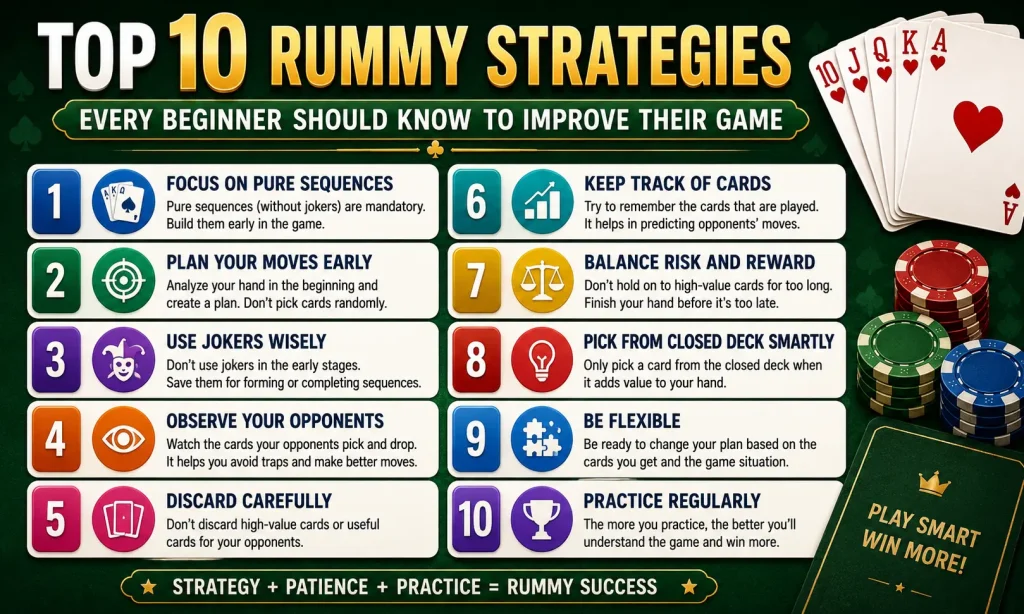
Rummy is one of the most popular card games in the world, enjoyed by players of all skill levels. While luck plays a role in the cards you receive, success in Rummy largely depends on strategy, observation, and decision-making. Many beginners jump into the game without understanding the fundamental tactics that experienced players use, which often leads to unnecessary losses.
The good news is that mastering Rummy does not require years of experience. By learning a few proven strategies and applying them consistently, beginners can significantly improve their gameplay and increase their chances of winning.
In this guide, we will explore the top 10 Rummy strategies every beginner should know to improve their game and become a more confident player.
1. Focus on Forming a Pure Sequence First
One of the most important rules in Rummy is that a valid declaration requires at least one pure sequence. A pure sequence is a group of consecutive cards from the same suit without using a joker.
For example:
- 4♠, 5♠, 6♠
- 7♥, 8♥, 9♥
Without a pure sequence, your declaration will be considered invalid, regardless of how well your remaining cards are arranged.
Why This Strategy Matters
Many beginners spend too much time creating sets and combinations while ignoring the pure sequence requirement. As a result, they end up with strong hands that cannot be declared.
Pro Tip
As soon as the game begins, identify cards that can help you form a pure sequence and prioritize them over other combinations.
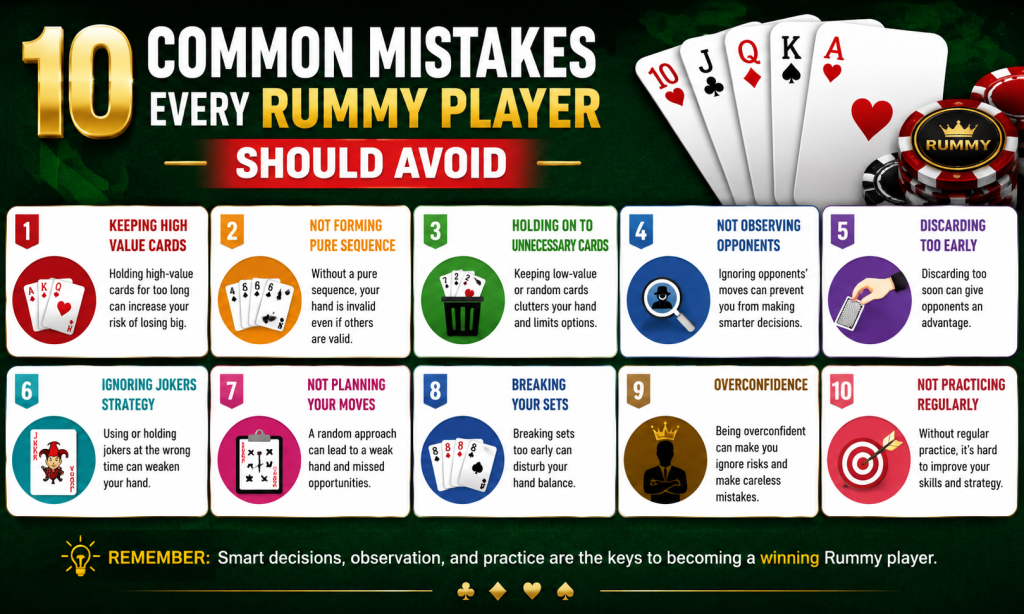
10 Common Mistakes Every Rummy Player Should Avoid
2. Observe Your Opponent’s Moves
Rummy is not just about your own cards. Paying attention to your opponent’s actions can provide valuable insights into their strategy.
Watch for:
- Cards they pick from the open deck
- Cards they discard
- Patterns in their gameplay
For example, if a player repeatedly picks heart cards, they may be trying to complete a sequence in that suit.
Benefits
Observing opponents helps you:
- Predict their combinations
- Avoid discarding useful cards
- Make smarter decisions
The more information you gather, the better your chances of staying ahead.
3. Use Jokers Wisely
Jokers are among the most powerful cards in Rummy because they can substitute for missing cards in sets and impure sequences.
For example:
- 5♣, Joker, 7♣
However, beginners often waste jokers on combinations that could be completed naturally.
Smart Joker Usage
Use jokers for:
- Difficult-to-complete sequences
- High-value cards
- Critical combinations
Avoid using a joker in a pure sequence because pure sequences cannot contain jokers.
Common Mistake
Many players reveal their strategy too early by using jokers unnecessarily. Keep your options open whenever possible.
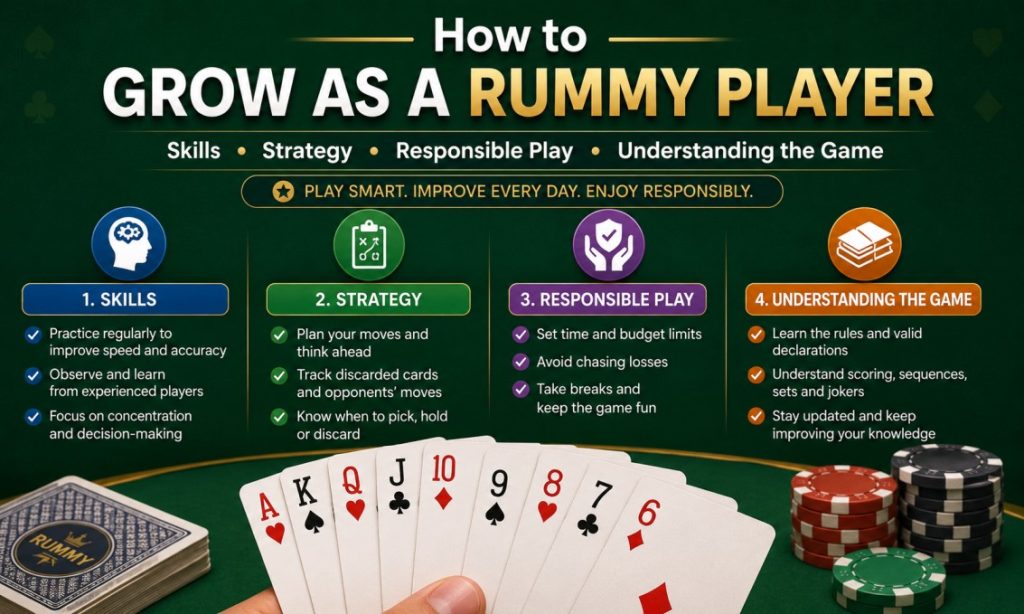
How to Grow as a Rummy Player: Skills, Strategy, Responsible Play, and Understanding the Game
4. Get Rid of High-Value Cards Early
Cards such as Kings, Queens, Jacks, and Aces carry high penalty points if you lose the game.
For example:
- King = 10 points
- Queen = 10 points
- Jack = 10 points
- Ace = 10 points
If these cards are not helping you build a sequence or set, they can become a liability.
Why It Matters
Suppose another player declares unexpectedly. Any unmatched high-value cards in your hand can significantly increase your score and losses.
Best Practice
Discard high-value cards early if they are not contributing to a useful combination.
5. Avoid Holding Too Many Middle Cards
Middle cards such as 5, 6, 7, and 8 are generally more flexible than high-value cards because they can fit into multiple sequences.
However, holding too many unrelated middle cards can clutter your hand and make decision-making difficult.
Example
If you have:
- 5♣
- 6♦
- 7♥
- 8♠
These cards belong to different suits and may not contribute to any meaningful combination.
Strategy
Keep only those middle cards that have realistic sequence-building potential.
6. Keep Track of Discarded Cards
Many beginners focus entirely on their own hand and ignore the discard pile.
This is a major mistake.
Tracking discarded cards can help you understand:
- Which sequences are no longer possible
- What your opponents are building
- Which cards are safe to discard
Example
If both the 7♠ and 8♠ have already been discarded, forming a sequence around 9♠ becomes much harder.
Advantage
This awareness prevents you from wasting turns chasing impossible combinations.

Rummy Bonus: Complete Guide to Online Rummy Bonuses in 2026
7. Avoid Revealing Your Strategy
Experienced players pay close attention to the cards you pick and discard.
If you consistently pick cards from the open pile, you may unintentionally reveal your plans.
Example
If you repeatedly pick diamond cards, opponents may realize you are building a diamond sequence.
Better Approach
Whenever possible:
- Use the closed deck
- Avoid obvious patterns
- Keep opponents guessing
The less information you give away, the stronger your position becomes.
8. Prioritize Flexible Combinations
Flexibility is crucial in Rummy because the game changes with every turn.
A flexible hand gives you more options for creating sequences and sets.
Example
Suppose you have:
- 6♣
- 7♣
You can potentially build:
- 5♣, 6♣, 7♣
- 6♣, 7♣, 8♣
This flexibility increases your chances of completing combinations quickly.
Strategy
Choose combinations that offer multiple possibilities rather than relying on a single card.

Rummy Modern: The Ultimate Guide, Review, Strategies & Everything You Need to Know in 2026
9. Practice Smart Discarding
Discarding is one of the most underrated skills in Rummy.
A poor discard can help your opponent complete their hand, while a smart discard can slow their progress.
Before Discarding, Ask Yourself:
- Does this card help my opponent?
- Is this card useful to me?
- Are there safer alternatives?
Safe Discarding Tips
- Discard isolated cards first.
- Remove high-value cards that lack potential.
- Avoid discarding cards recently connected to your opponent’s picks.
Smart discarding minimizes risk and improves overall gameplay.
10. Stay Patient and Avoid Rushed Decisions
Many beginners become frustrated when they do not get the cards they need.
As a result, they make impulsive decisions that hurt their chances of winning.
Common Examples
- Breaking a nearly completed sequence
- Discarding useful cards too quickly
- Making premature declarations
The Importance of Patience
Rummy rewards players who think strategically and remain calm under pressure.
Take time to evaluate:
- Available combinations
- Opponent behavior
- Future possibilities
A patient player often outperforms a reckless one.
Bonus Tips for Beginners
In addition to the top 10 strategies above, here are a few extra tips that can improve your game:
Practice Regularly
Like any skill-based game, improvement comes through consistent practice.
Learn from Every Match
Analyze:
- Winning hands
- Mistakes made
- Missed opportunities
Stay Focused
Avoid distractions during gameplay. Even a single missed observation can affect your decisions.
Manage Risks
Do not become attached to difficult combinations that have little chance of being completed.
Adapt when necessary.

Aaj Kal Rummy Apps Kis Tarah Ke Bonus Dete Hain?
Common Beginner Mistakes to Avoid
Many new players struggle because they repeatedly make the same errors.
Here are some mistakes to watch out for:
- Ignoring the pure sequence requirement
- Holding high-value cards too long
- Using jokers inefficiently
- Not tracking discarded cards
- Revealing strategy through obvious picks
- Declaring without double-checking combinations
- Playing too aggressively
- Chasing impossible sequences
Avoiding these mistakes can dramatically improve your performance.
Conclusion
Rummy is a game that combines skill, observation, strategy, and decision-making. While beginners often focus solely on creating combinations, experienced players understand that success comes from managing cards efficiently, observing opponents, and making calculated moves.
By applying these top 10 Rummy strategies, you can develop stronger gameplay habits and improve your chances of success. Start by focusing on a pure sequence, use jokers wisely, monitor your opponents, and avoid unnecessary risks. Over time, these habits will become second nature and help you become a more confident and competitive player.
Remember, the goal is not just to play more games but to play smarter games. With patience, practice, and the right strategy, every beginner can steadily improve and enjoy greater success at the Rummy table.
The most important strategy is forming a pure sequence as early as possible. Without a pure sequence, a valid declaration cannot be made.
Not necessarily. Jokers should be saved for difficult combinations or high-value cards where they provide maximum benefit.
Observing opponents helps you understand their strategy, predict their needs, and avoid giving them useful cards.
High-value cards should be discarded early if they are not contributing to a sequence or set.
Practice regularly, analyze your mistakes, learn effective strategies, and pay attention to your opponents’ moves.
While card distribution involves chance, long-term success in Rummy depends heavily on skill, strategy, observation, and decision-making.
Common mistakes include ignoring pure sequences, holding high-value cards too long, using jokers poorly, and failing to observe opponents.
Most Rummy formats require at least two sequences, including one pure sequence, for a valid declaration.
It depends on the situation. Picking from the open pile can help complete combinations, but it may reveal your strategy to opponents.


Leave a Reply