
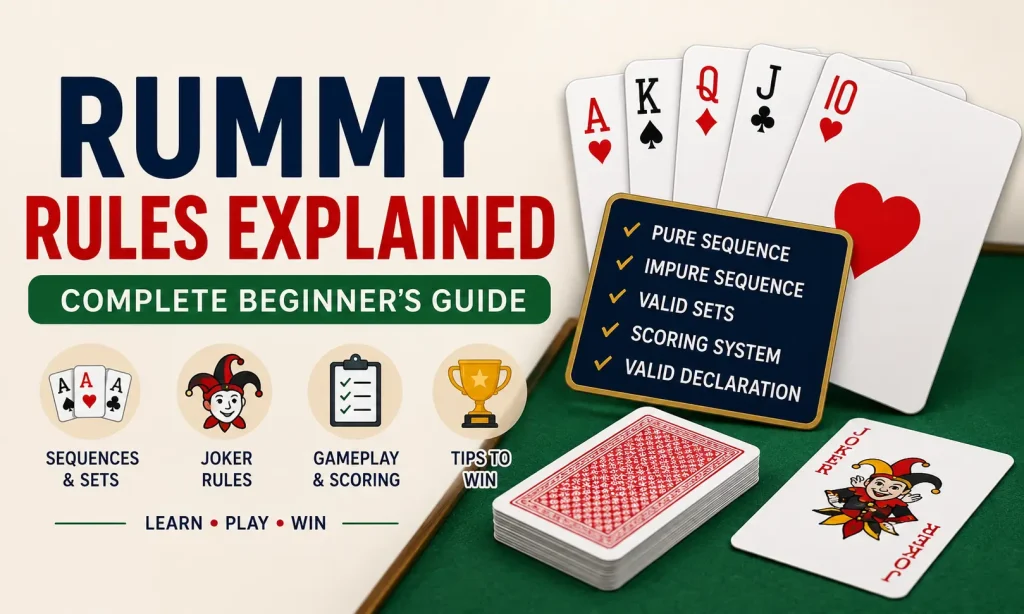
Introduction
Rummy is one of the most popular card games in India, enjoyed by millions of players for its combination of strategy, observation, and skill. Whether you play with friends at home or use an online platform, understanding the rules of rummy is essential before starting your first game.
Many beginners lose games simply because they do not understand concepts like pure sequence, impure sequence, valid sets, or the correct declaration process. Learning these basics can make the game easier to understand and more enjoyable.
This complete beginner’s guide explains the rules of rummy step by step, including card distribution, gameplay, sequences, sets, scoring, common mistakes, and practical tips for new players.

Dragon Tiger Game: Complete Guide, Rules, History, Strategy, Advantages & Risks
What Is Rummy?
Rummy is a card game in which players arrange their cards into valid combinations known as sequences and sets. The objective is to organize all the cards into these combinations before making a valid declaration.
Unlike games that rely entirely on luck, rummy involves observation, planning, and decision-making. Every move requires players to evaluate which cards to keep, which to discard, and how to improve their hand.
Today, rummy can be played in traditional offline settings as well as on online platforms that support multiple game formats.
Objective of the Game
The main goal in rummy is simple:
- Arrange all cards into valid sequences and sets.
- Create at least one pure sequence.
- Declare your cards correctly before other players.
Without a pure sequence, a declaration is generally considered invalid under standard rummy rules.
Number of Players
Rummy can usually be played by:
- 2 Players
- 3 Players
- 4 Players
- 5 Players
- 6 Players
Some formats also allow more players by using additional decks of cards.
Cards Used in Rummy
A standard rummy game uses one or more 52-card decks, depending on the number of players.
Each deck contains four suits:
- Hearts ♥
- Diamonds ♦
- Clubs ♣
- Spades ♠
Each suit has thirteen cards:
- A
- 2–10
- Jack (J)
- Queen (Q)
- King (K)
Many rummy formats also include printed jokers and selected wild jokers.
Card Distribution
At the beginning of the game:
- Every player receives a fixed number of cards.
- One card is placed face-up to start the discard pile.
- The remaining cards form the draw pile.
- Players take turns drawing and discarding one card.
The exact number of cards may vary depending on the game variation.
Basic Gameplay
Every turn follows a simple sequence:
Step 1: Draw a Card
A player draws one card either from the closed deck or the open discard pile.
Step 2: Arrange Cards
The player checks whether the new card helps complete a sequence or a set.
Step 3: Discard One Card
The player discards one unwanted card to end the turn.
This cycle continues until someone forms valid combinations and makes a correct declaration.
What Is a Sequence?
A sequence is a group of consecutive cards belonging to the same suit.
Example:
- 4♥ 5♥ 6♥
- 8♠ 9♠ 10♠
- J♦ Q♦ K♦
Sequences are the most important part of rummy because they are required for a valid declaration.

All Rummy Apps in India 2026: The Ultimate Guide to Online Rummy Platforms
Pure Sequence Explained
A pure sequence contains three or more consecutive cards of the same suit without using a joker.
Examples:
- 5♣ 6♣ 7♣
- A♠ 2♠ 3♠
- 10♦ J♦ Q♦
Every player should focus on creating a pure sequence as early as possible.
Impure Sequence Explained
An impure sequence uses one or more jokers to complete the sequence.
Examples:
- 7♥ 8♥ Joker
- Q♣ Joker A♣
Although an impure sequence is valid, it cannot replace the requirement for at least one pure sequence.
What Is a Set?
A set consists of three or four cards of the same rank but different suits.
Examples:
- 7♠ 7♥ 7♦
- K♣ K♦ K♥
- 10♣ 10♦ 10♥ 10♠
Duplicate suits are not allowed in a valid set.
Joker Rules
Jokers are special cards that can substitute for missing cards in sets and impure sequences.
However, jokers cannot be used to create a pure sequence.
Understanding when to use a joker and when to save it is an important strategic decision.
Valid Declaration
A valid declaration generally includes:
- At least two sequences.
- One mandatory pure sequence.
- Remaining cards arranged into valid sequences or sets.
Only after completing all combinations should a player declare.
Invalid Declaration
A declaration is usually considered invalid if:
- There is no pure sequence.
- Cards are not arranged into valid combinations.
- The declaration contains errors.
An invalid declaration may result in penalty points according to the game’s rules.
Rummy Scoring
Although scoring varies across different formats, the general principles include:
- Face cards carry higher point values.
- Number cards count according to their face value.
- Valid declarations help minimize points.
- Unmatched cards contribute to the player’s total score if another player declares first.
Always check the scoring rules for the specific variation you are playing.
Common Mistakes Beginners Make
Many new players repeat the same errors:
- Ignoring the pure sequence.
- Holding unnecessary high-value cards.
- Declaring too early.
- Forgetting to observe discarded cards.
- Keeping unrelated cards for too long.
Avoiding these mistakes can improve consistency and decision-making.
Tips for Beginners
- Learn the rules before playing.
- Build a pure sequence first.
- Organize your cards after every draw.
- Watch opponents’ discarded cards.
- Practice regularly to improve your understanding of the game.
- Stay patient and avoid rushing your declaration.
Responsible Play
Rummy should always be enjoyed as a recreational activity. Set personal limits for time and spending, take regular breaks, and avoid playing when stressed or emotional. Responsible play helps maintain a healthy balance between entertainment and everyday life.
Conclusion
Understanding rummy rules is the first step toward enjoying the game confidently. By learning how sequences, sets, jokers, scoring, and declarations work, beginners can avoid common mistakes and gradually improve their gameplay. Practice, patience, and a solid understanding of the rules are the keys to becoming a better rummy player.
Whether you are playing casually with friends or exploring online platforms, always review the rules of the format you choose and remember to play responsibly.
Advanced Rummy Guide for Beginners
Understanding Card Combinations
Learning how to recognize useful card combinations is one of the most important parts of improving your rummy skills. Every card you draw or discard should support your goal of creating valid sequences and sets.
For example, if you already have 4♠ and 5♠, drawing 6♠ immediately completes a pure sequence. Likewise, if you hold 8♦ and 8♣, drawing 8♥ forms a valid set.
As you gain experience, you’ll begin to identify multiple possible combinations from the same hand and decide which option gives you the best chance of completing a valid declaration.
Importance of Planning
Successful rummy players rarely make random decisions. Instead, they plan several moves ahead. Rather than focusing only on the next card, they think about how different draws might improve their hand.
Planning includes:
- Identifying possible sequences early.
- Keeping flexible card combinations.
- Avoiding unnecessary high-value cards.
- Watching the discard pile carefully.
Good planning often leads to fewer mistakes during the game.

Gin Rummy App Review – Complete Guide, Features, Gameplay & Tips
Card Observation Skills
Observation is another essential part of rummy.
By watching which cards other players discard, you may gain clues about the combinations they are trying to build.
For instance:
- If several players discard Hearts, completing a Hearts sequence may become more difficult.
- If a player repeatedly picks from the discard pile, they may be close to completing a combination.
Observation does not guarantee success, but it helps improve decision-making.
Managing High-Value Cards
Face cards such as King, Queen, and Jack generally carry higher point values in many rummy formats.
If these cards do not contribute toward useful combinations, experienced players often choose to discard them rather than keeping them throughout the game.
Reducing unnecessary high-value cards can help lower your score if another player declares before you.
Organizing Your Cards
Many beginners keep cards in random order.
A better approach is to arrange cards into groups:
- Possible pure sequences
- Possible impure sequences
- Possible sets
- Unmatched cards
Proper organization allows quicker decisions during every turn.
Understanding Jokers
Jokers are valuable because they can substitute for missing cards in many combinations.
However, beginners sometimes make the mistake of using a joker too early.
In many situations, saving a joker for a more difficult combination may be a better decision.
Remember that a joker cannot replace the requirement for a pure sequence under standard rules.
Sample Gameplay
Suppose your cards are:
4♥ 5♥ 6♥
8♠ 8♦
10♣ J♣
K♦
3♣
9♠
Joker
You already have one pure sequence:
4♥ 5♥ 6♥
Now your objective is to build another sequence and complete one or more sets.
Every draw should help improve these combinations while removing unnecessary cards.
Practice Makes Improvement
Nobody becomes an expert after only a few games.
Practicing regularly helps you:
- Recognize useful combinations faster.
- Reduce mistakes.
- Improve observation.
- Learn better card management.
- Make quicker decisions.
Many players improve simply by reviewing their previous games and identifying where they could have made better choices.
Common Beginner Questions
Should I build a pure sequence first?
Yes. Since a pure sequence is generally required for a valid declaration, it should usually be your first priority.
Should I keep every joker?
Not always.
Although jokers are valuable, they should be used wisely rather than collected without a clear purpose.
Is every draw important?
Yes.
Every card changes your available options and may influence your next decision.
Different Rummy Variations
Across different regions, several variations of rummy are played.
Some popular versions include:
- Indian Rummy
- Gin Rummy
- Contract Rummy
- Kalooki
- Oklahoma Rummy
- Canasta
Although the objective remains similar, rules and scoring may differ.
Improving Memory
Memory plays a useful role in rummy.
Experienced players often remember:
- Frequently discarded cards.
- Recently picked cards.
- Possible combinations.
- Cards already used in sequences.
Improving memory helps reduce unnecessary guesses.
Staying Patient
Many beginners rush to declare.
Instead, carefully verify every combination before declaring.
Taking a few extra seconds to review your cards may help avoid an invalid declaration.

Online Rummy Apps in India (2026): Complete Guide, Rules, Features, Safety Tips & Responsible Play
Learning From Every Game
Every completed game provides an opportunity to learn.
Ask yourself:
- Did I discard the right cards?
- Did I create a pure sequence early enough?
- Could I have organized my cards better?
- Did I observe opponents carefully?
Small improvements gradually lead to better overall performance.
Responsible Play Reminder
Whether playing casually with family or on digital platforms, remember that rummy should remain a recreational activity.
Set reasonable limits for your time, avoid excessive play, and maintain a healthy balance with work, study, and family responsibilities.
Final Thoughts
Rummy is a classic card game that rewards careful planning, observation, and logical thinking. Beginners should focus first on understanding the basic rules, creating valid sequences, and practicing regularly. Over time, experience helps players recognize patterns, organize their cards efficiently, and make more confident decisions.
With patience and consistent practice, anyone can develop a better understanding of the game while enjoying it as a fun and strategic card game.


Leave a Reply